
In the era of distributed systems, container orchestration, and microservices, traditional monitoring falls short of providing the insights needed for fast, reliable software delivery. Observability steps in as a fundamental DevOps capability, enabling teams to deeply understand system behavior by correlating logs, metrics, and traces. It’s not just about identifying when something breaks—it’s about pinpointing why it broke and where, in real time. Tools like OpenTelemetry, Prometheus, Grafana, and Jaeger are at the forefront of this shift, helping engineers instrument systems and troubleshoot with precision.
Whether you’re deploying dozens of microservices or maintaining a high-traffic monolith, observability has become a cornerstone of resilient, high-performing software delivery. In this blog, we’ll explore why observability is more than just a buzzword—it’s a strategic advantage for any DevOps team aiming to ship faster, recover quicker, and sleep better.
💡Introduction to Observability
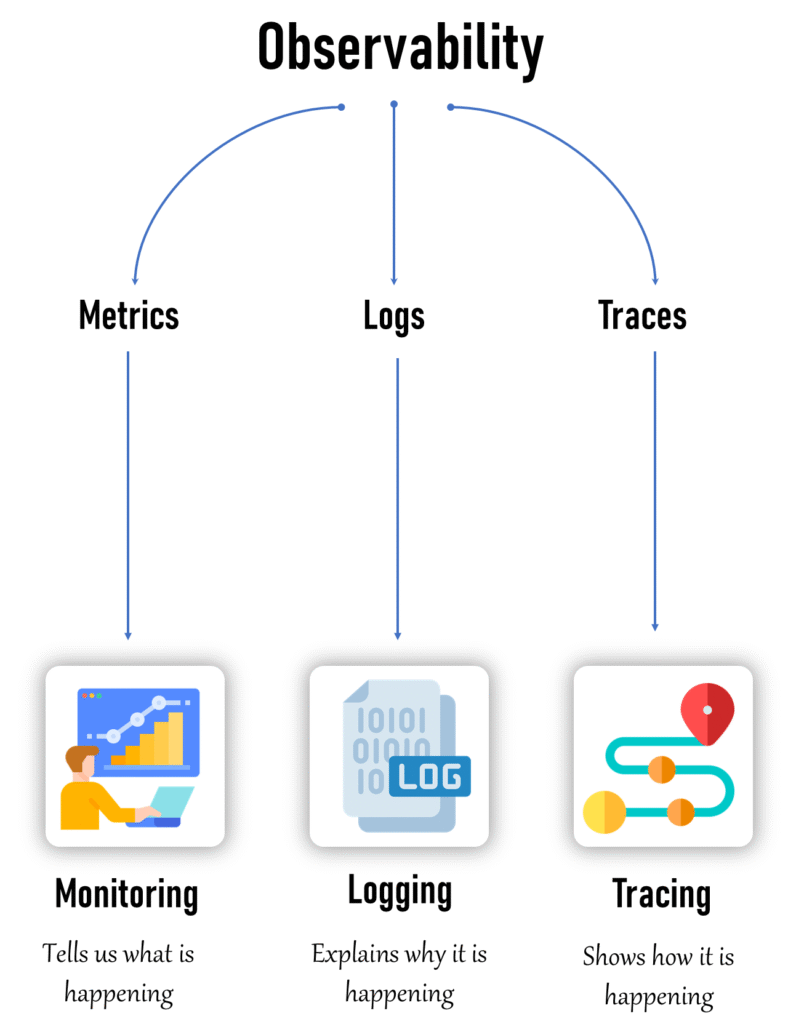
Observability is the ability to understand the internal state of a system by analyzing the data it produces, including logs, metrics, and traces.
🤔Why Monitoring?
- Monitoring helps us keep an eye on our systems to ensure they are working properly.
- Purpose: maintaining the health, performance, and security of IT environments.
- It enables early detection of issues, ensuring that they can be addressed before causing significant downtime or data loss.
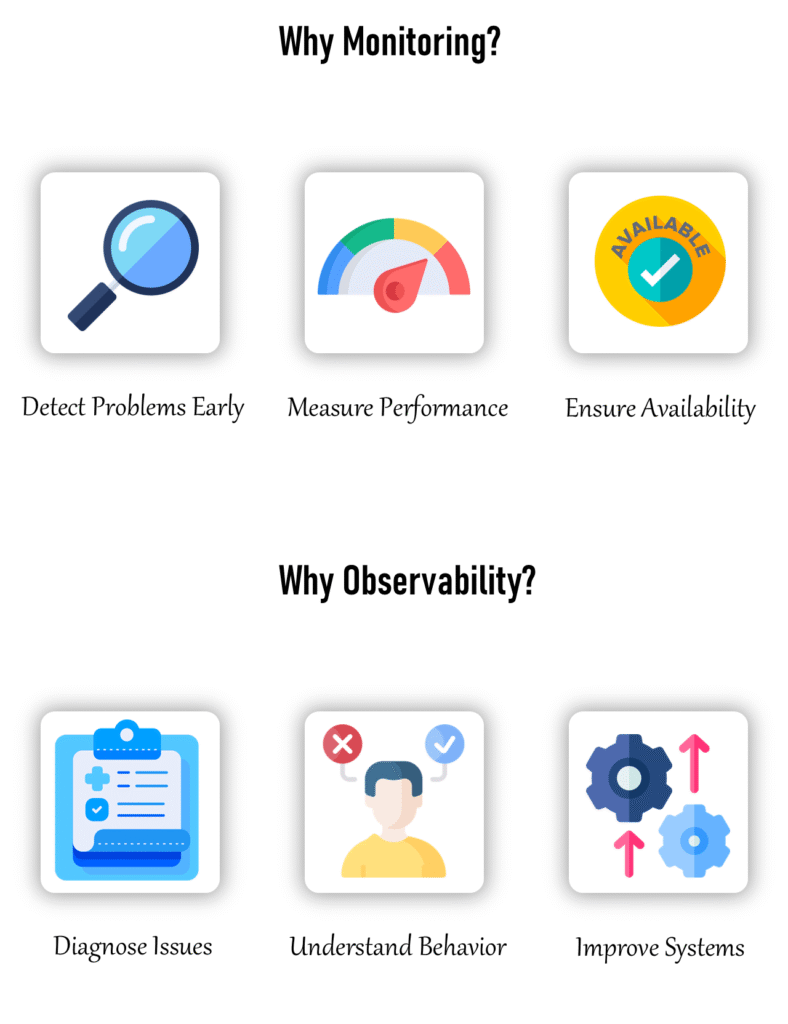
- We use monitoring to detect problems early, measure performance, ensure availability
🤔Why Observability
- Observability helps us understand why our systems are behaving the way they are.
- It’s like having a detailed map and tools to explore and diagnose issues.
- We use observability to diagnose issues, understand behavior, improve systems.
🆚Difference between Monitoring and Observability
| Category | Monitoring | Observability |
| Focus | Checking if everything is working as expected | Understanding why things are happening in the system |
| Data | Collects metrics like CPU usage, memory usage, and error rates | Collects logs, metrics, and traces to provide a full picture |
| Alerts | Sends notifications when something goes wrong | Correlates events and anomalies to identify root causes |
| Example | If a server’s CPU usage goes above 90%, monitoring will alert us | If a website is slow, observability helps us trace the user’s request through different services to find the bottleneck |
| Insight | Identifies potential issues before they become critical | Helps diagnose issues and understand system behavior |
🆚Monitoring on Bare-Metal Servers vs. Monitoring Kubernetes
- Bare-Metal Servers:
- Direct Access: Easier access to hardware metrics and logs.
- Fewer Layers: Simpler environment with fewer abstraction layers.
- Kubernetes:
- Dynamic Environment: Challenges with monitoring ephemeral containers and dynamic scaling.
- Distributed Nature: Requires tools that can handle distributed systems and correlate data from multiple sources.
🆚Observing on Bare-Metal Servers vs. Observing Kubernetes
- Bare-Metal Servers:
- Simpler Observability: Easier to collect and correlate logs, metrics, and traces due to fewer components and layers.
- Kubernetes:
- Complex Observability: Requires sophisticated tools to handle the dynamic and distributed nature of containers and microservices.
- Integration: Necessitates the integration of multiple observability tools to get a complete picture of the system.
⚒️What are the Tools Available?
- Monitoring Tools: Prometheus, Grafana, Nagios, Zabbix, PRTG.
- Observability Tools: ELK Stack (Elasticsearch, Logstash, Kibana), EFK Stack (Elasticsearch, FluentBit, Kibana) Splunk, Jaeger, Zipkin, New Relic, Dynatrace, Datadog.